Sumitomo Mitsui Financial Group, Inc. Signals a Pragmatic Shift Toward Transition Finance Leadership in Its 2025 Sustainability Report
Sumitomo Mitsui Financial Group, Inc. (SMBC Group) has released its 2025 Sustainability Report, highlighting progress in transition finance, climate risk integration, and expanding focus on natural capital and human rights across its global operations.
Sumitomo Mitsui Financial Group (SMBC Group) has released its Sustainability Report 2025, outlining how sustainability is embedded as a core pillar of its current medium-term strategy under the theme of “creating social value.”
The report is positioned as a comprehensive disclosure covering governance, strategy, risk management, and metrics—aligned with major frameworks such as TCFD/ISSB-style structures and expanding into TNFD and impact reporting.
For stakeholders, the release matters not just as a disclosure update, but as a signal of how a major global financial institution is evolving its role—from capital provider to transition enabler—particularly in Asia and other transition-heavy markets.
Key sustainability themes and disclosures
The report is structured around four core pillars: climate change, natural capital, human rights, and human capital, reflecting SMBC’s updated material issues.
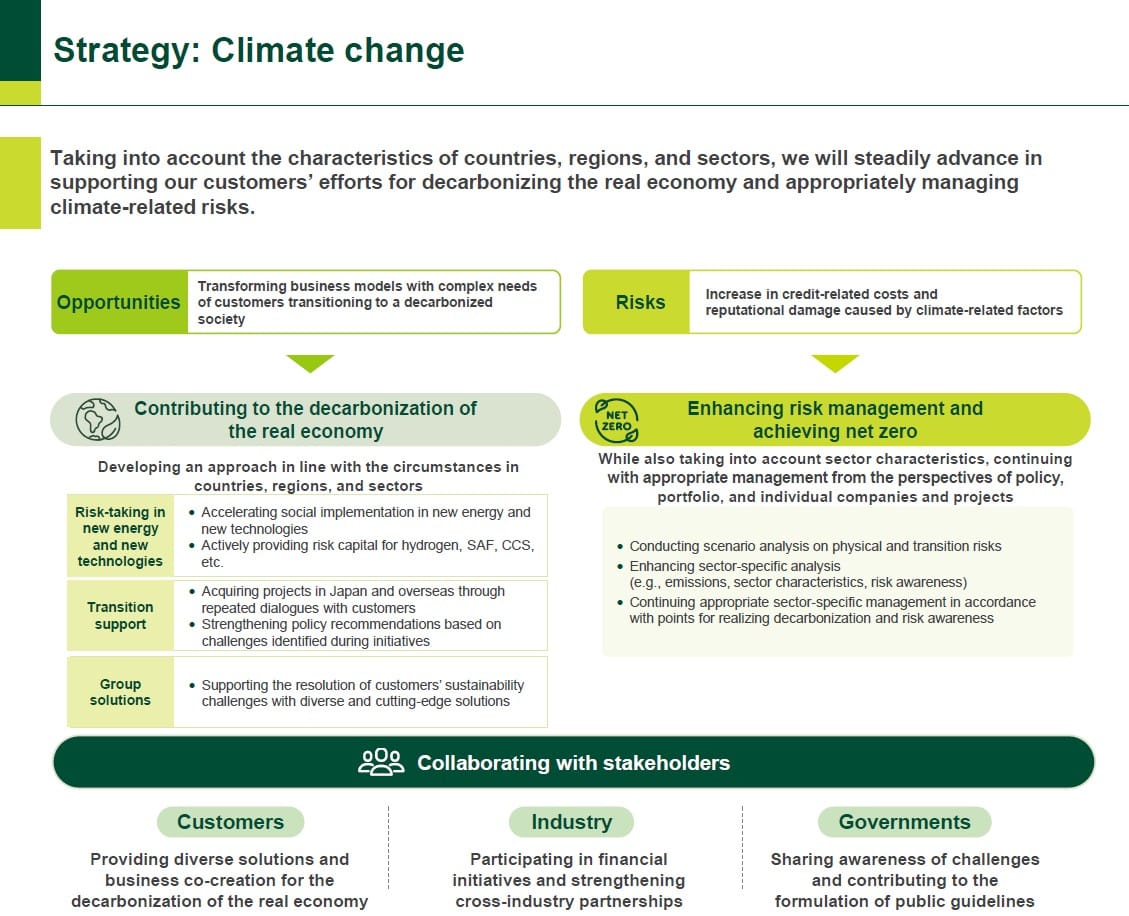
Climate remains the dominant theme. SMBC emphasizes transition finance as a key mechanism, with 46 deals executed and engagement with over 130 clients, alongside a broader target of JPY 50 trillion in sustainable finance by 2030.
This is complemented by quantified decarbonisation pathways, including sector-specific portfolio targets and a net-zero commitment by 2050 for financed emissions.
Natural capital emerges as a more prominent second pillar, with concrete initiatives such as the acquisition of 220 hectares of forest (“SMBC’s Forests”) and the development of nature-related finance products.
The report also shows early adoption of TNFD-aligned thinking, including dependency/impact analysis and sector heatmaps.
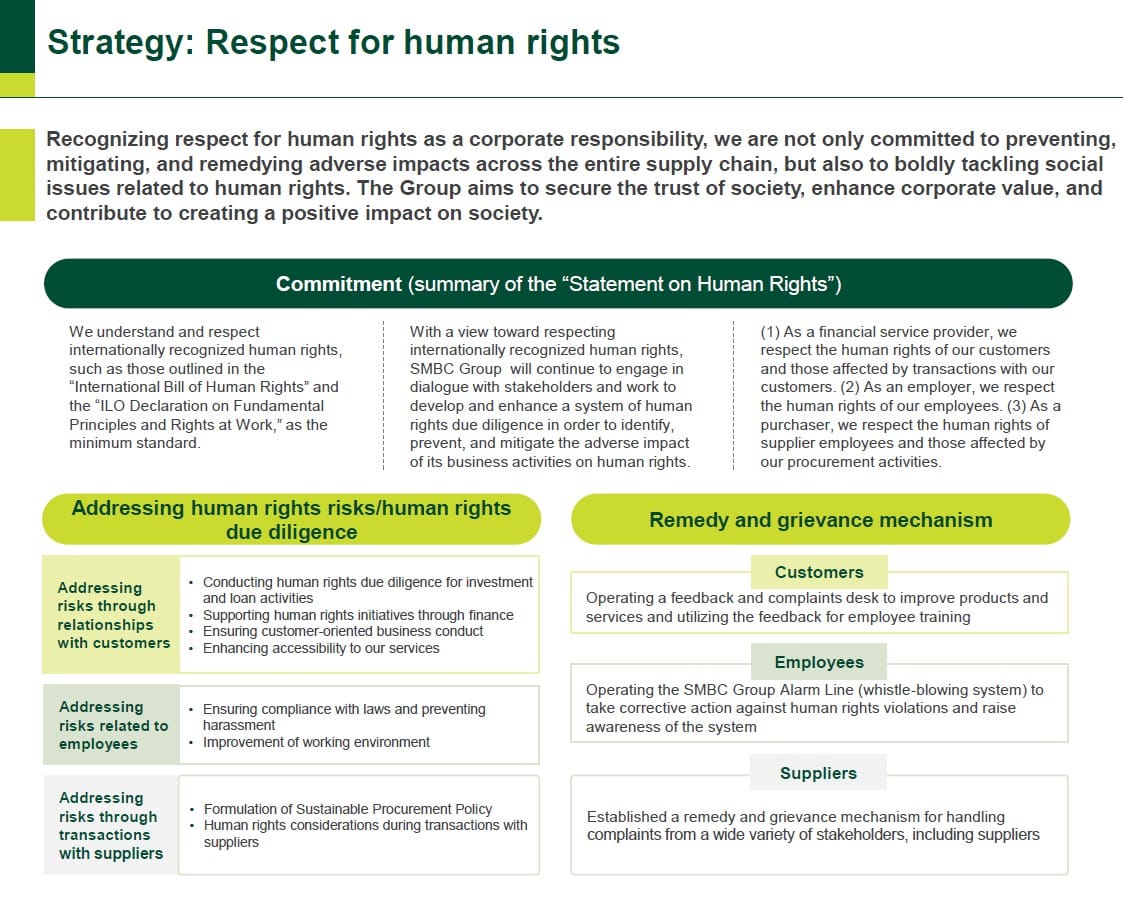
On the social side, SMBC strengthens its human rights positioning through updated policies, supply chain due diligence, and a formal grievance mechanism aligned with UN Guiding Principles.
Meanwhile, human capital is framed as a strategic asset, supported by measurable KPIs such as engagement scores, diversity targets, and increased investment in employee development.
Governance and strategic signals
Governance disclosures suggest a maturing sustainability architecture. The Board, Sustainability Committee, and Group CSuO (Chief Sustainability Officer) play defined roles in oversight and execution.
Notably, sustainability is now embedded into executive compensation through both quantitative (e.g., financed emissions, sustainable finance volume) and qualitative indicators, reinforcing accountability.
From a strategic standpoint, the report emphasizes integration rather than standalone ESG initiatives. Environmental and social risks—particularly climate, biodiversity, and human rights—are incorporated into the enterprise risk management framework and risk appetite setting, including scenario analysis to 2050.
There is also a clear shift toward sector-level transition management, with detailed decarbonisation pathways for high-impact industries such as power, oil & gas, steel, and automotive—indicating a portfolio-level approach rather than project-by-project ESG screening.
What this report suggests about future direction
The 2025 report signals that SMBC is positioning itself as a transition finance leader, particularly in regions where decarbonisation pathways are complex and non-linear. Its emphasis on balancing energy security with decarbonisation suggests a pragmatic stance aligned with real-economy constraints.
The expansion into natural capital and TNFD-aligned disclosures indicates a likely broadening from climate-centric to multi-capital sustainability strategy, with biodiversity and ecosystem services becoming increasingly material.
At the same time, the integration of ESG into risk management and compensation frameworks suggests a continued shift toward fully embedded sustainability governance, rather than disclosure-led compliance.
Overall, the direction of travel points toward deeper client engagement, more sophisticated portfolio analytics, and increased use of finance as a lever for systemic transition.
Pacifica ESG View
SMBC’s 2025 report reflects a clear evolution from ESG disclosure to strategic execution. The combination of transition finance scale, sector-level decarbonisation pathways, and integration into risk governance suggests growing credibility. The next signal to watch will be consistency between stated transition support and portfolio reallocation—particularly in high-emission sectors where real-economy impact is most material.