From Sustainable Mobility to Urban Value Creation: An MTR ESG Analysis
MTR integrates sustainability into its rail and property model, aligning low-carbon transport with urban development. Its governance-led approach, climate focus, and measurable KPIs position the Group as a resilient infrastructure operator in a transitioning ESG landscape.
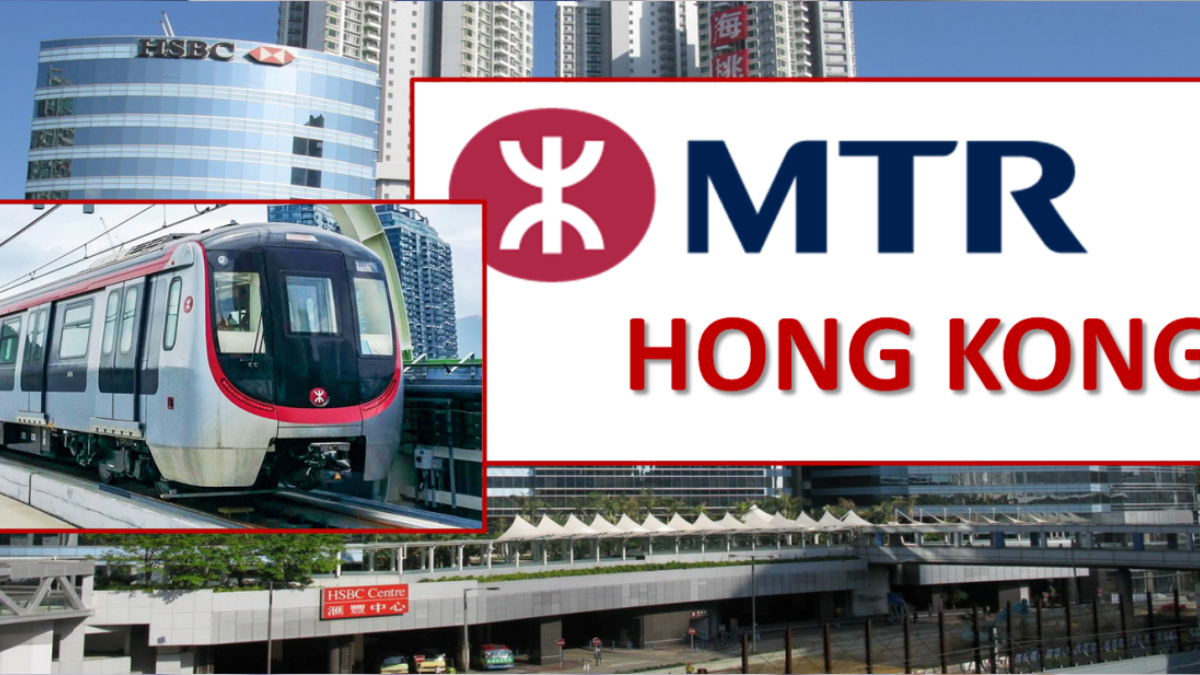
MTR’s 2024 Sustainability Report reflects a mature, multi-framework reporting approach aligned with HKEX ESG Code (including forward-looking reference to new climate disclosure requirements), GRI Standards, ISSB (IFRS S1/S2), TCFD, and TNFD . The report covers global operations across Hong Kong, Mainland China, and international markets, with a clear boundary on controlled subsidiaries and exclusions transparently disclosed. This indicates a high level of reporting discipline and readiness for evolving regulatory expectations, particularly HKEX’s upcoming climate-related disclosure requirements effective from 2025.
The integration of annual report, sustainability website, and standalone report demonstrates a “combined reporting ecosystem” rather than a single document approach. This enhances accessibility and suggests a shift toward continuous disclosure rather than static annual reporting. For investors, this structure supports better traceability of ESG performance to financial outcomes and strategy.
Governance and oversight mechanisms
MTR demonstrates a well-defined ESG governance architecture anchored at Board level, with the Environmental & Social Responsibility Committee (E&SRC) providing strategic oversight and monitoring ESG KPIs . At management level, the Environmental & Social Responsibility Steering Committee (E&SRSC) operationalises ESG initiatives across business units, supported by an enterprise risk management (ERM) framework that integrates sustainability risks.
Notably, sustainability performance is linked to management remuneration, signalling strong internal accountability and alignment with global best practice. The presence of multiple Board committees, alongside an advisory panel and external review panel, reinforces governance robustness and introduces independent perspectives into ESG strategy and reporting quality.
From a regulatory and investor lens, this layered governance structure aligns with ISSB and HKEX expectations on oversight, risk integration, and accountability. It also positions MTR as a relatively advanced issuer in embedding ESG into corporate governance rather than treating it as a compliance exercise.
Material topics and risk lens
MTR adopts a structured materiality assessment aligned with GRI, IFRS S1, and HKEX principles, incorporating both stakeholder impact and financial materiality . The integration of materiality outcomes into enterprise risk management reflects a transition toward double materiality thinking, even as the methodology continues to evolve.
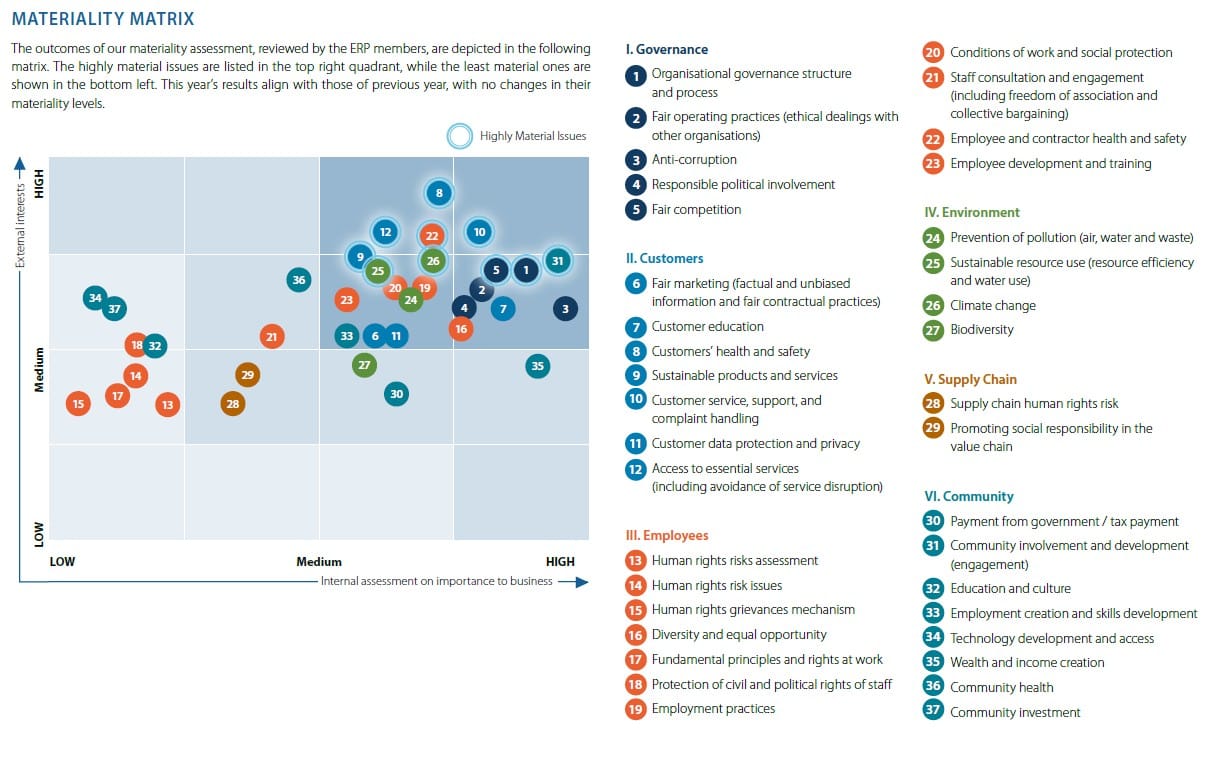
The top material topics span governance (e.g. organisational governance and fair competition), customer safety and service reliability, employee health and safety, climate change, and community engagement . These topics are closely linked to MTR’s operational model as a public transport operator, where safety, reliability, and accessibility directly affect both societal impact and financial performance.
Importantly, the report highlights three structural megatrends—climate resilience, ageing population, and digital transformation—which frame ESG risks and opportunities. This forward-looking lens indicates that MTR is not only responding to current ESG risks but also positioning itself against long-term systemic shifts affecting urban mobility and infrastructure.
Metrics, targets, and performance signals
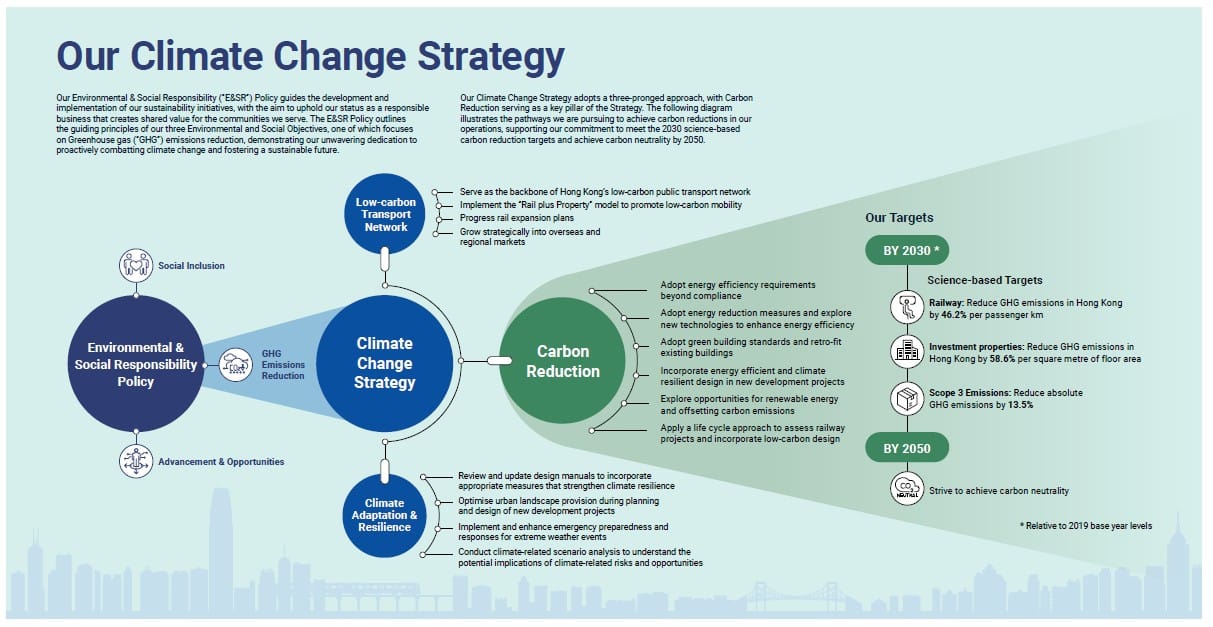
MTR’s ESG strategy is operationalised through three Environmental and Social Objectives (E&SOs): social inclusion, advancement and opportunities, and greenhouse gas emissions reduction, supported by 43 KPIs in 2024 . The company reports that all KPIs are either achieved or on track, suggesting strong internal execution discipline.
Climate targets are particularly notable, with Science Based Targets initiative (SBTi)-approved goals to reduce emissions by approximately 50% by 2030 and achieve carbon neutrality by 2050 . Operational initiatives—such as electrification, renewable energy deployment, hydrogen and electric transport trials, and energy efficiency upgrades—demonstrate tangible progress toward decarbonisation.
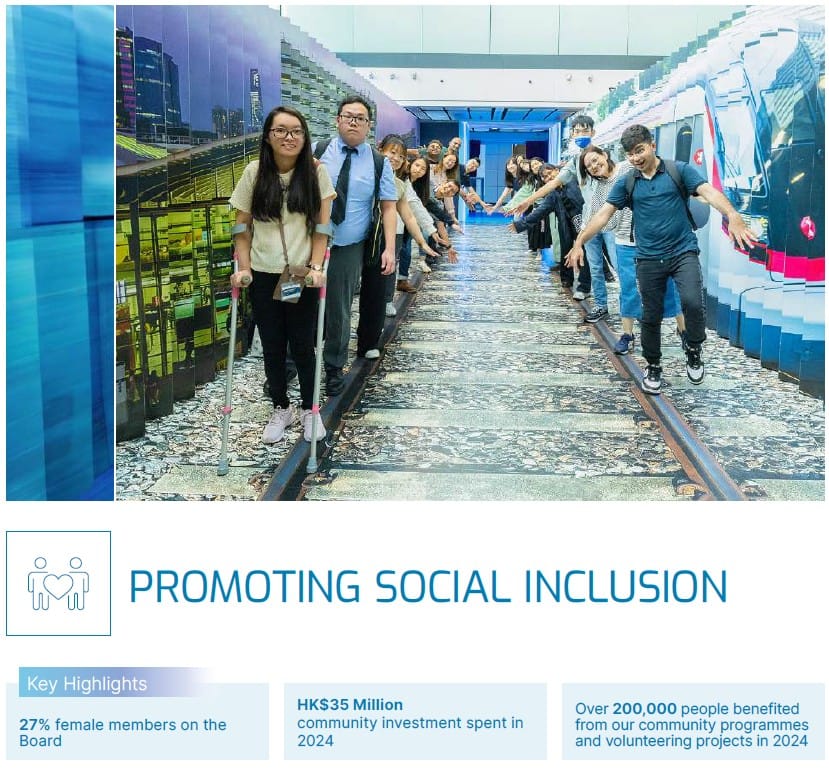
On the social side, performance indicators such as over one million daily passenger trips benefiting from fare concessions, 27% female board representation, and extensive DEI training programmes provide measurable signals of social impact.
From an investor perspective, the breadth of KPIs across environmental, social, and operational domains reflects a comprehensive performance management system. However, while target achievement rates are strong, further granularity on year-on-year performance trends and intensity metrics would enhance analytical comparability.
Credibility, assurance, and transparency
MTR’s sustainability disclosures are supported by independent assurance of key quantitative data by KPMG, enhancing credibility . In addition, the use of an External Review Panel introduces an additional layer of qualitative review, improving transparency and disclosure quality.
The report also demonstrates strong alignment with global frameworks and indices, including inclusion in MSCI AAA rating, FTSE4Good, and S&P Global Sustainability Yearbook . These external recognitions provide third-party validation of ESG performance and reporting maturity.
Transparency is further reinforced through detailed disclosures on governance processes, whistleblowing cases, safety incidents, and KPI performance status. This level of openness supports stakeholder trust and aligns with expectations under ISSB and HKEX regimes.
Overall, MTR’s assurance and transparency approach positions it as a high-credibility ESG reporter, although expansion into full-scope assurance (e.g. ISSA 5000-style assurance in future) could further strengthen investor confidence.
Strategic positioning and ESG maturity
MTR’s ESG strategy is closely integrated with its core business model as a low-carbon mass transit operator. The “Rail plus Property” model not only supports financial sustainability but also enables integrated urban development aligned with sustainable cities objectives.
The company’s positioning as a provider of low-carbon transport infrastructure places it structurally aligned with global decarbonisation trends. Its investments in green bonds, sustainable finance frameworks, and ESG-linked financing further reinforce this positioning.
At a maturity level, MTR demonstrates characteristics of an advanced ESG integrator: governance integration, KPI-driven management, alignment with multiple frameworks, and linkage to financial and operational strategy. Its focus on megatrends and innovation—such as digitalisation and inclusive mobility—indicates a transition from compliance-driven ESG to value-creation ESG.
For customers and regulators, this translates into a model of infrastructure-led sustainability, where ESG is embedded in service delivery and long-term urban development.
Pacifica ESG View
MTR’s 2024 Sustainability Report reflects a high level of ESG integration, with governance, strategy, and performance management closely aligned to global standards and regulatory expectations. Its strength lies in linking ESG objectives directly to core operations—particularly low-carbon transport and inclusive mobility—rather than treating ESG as an overlay. The combination of strong governance, credible assurance, and measurable KPIs supports investor confidence. Going forward, enhanced disclosure of performance trends and financial impacts of ESG initiatives could further strengthen its positioning as a benchmark issuer in infrastructure sustainability.
Forward-looking signals
MTR appears well positioned for HKEX’s upcoming climate disclosure requirements and broader ISSB-aligned reporting expectations. Its evolving double materiality approach and integration of ESG into risk management suggest readiness for more stringent regulatory scrutiny. Continued investment in low-carbon technologies and sustainable finance indicates a trajectory toward deeper decarbonisation leadership. However, as expectations shift toward quantified climate risk impacts and Scope 3 transparency, further enhancement in scenario analysis and value chain disclosures will likely be key to maintaining its leadership position.